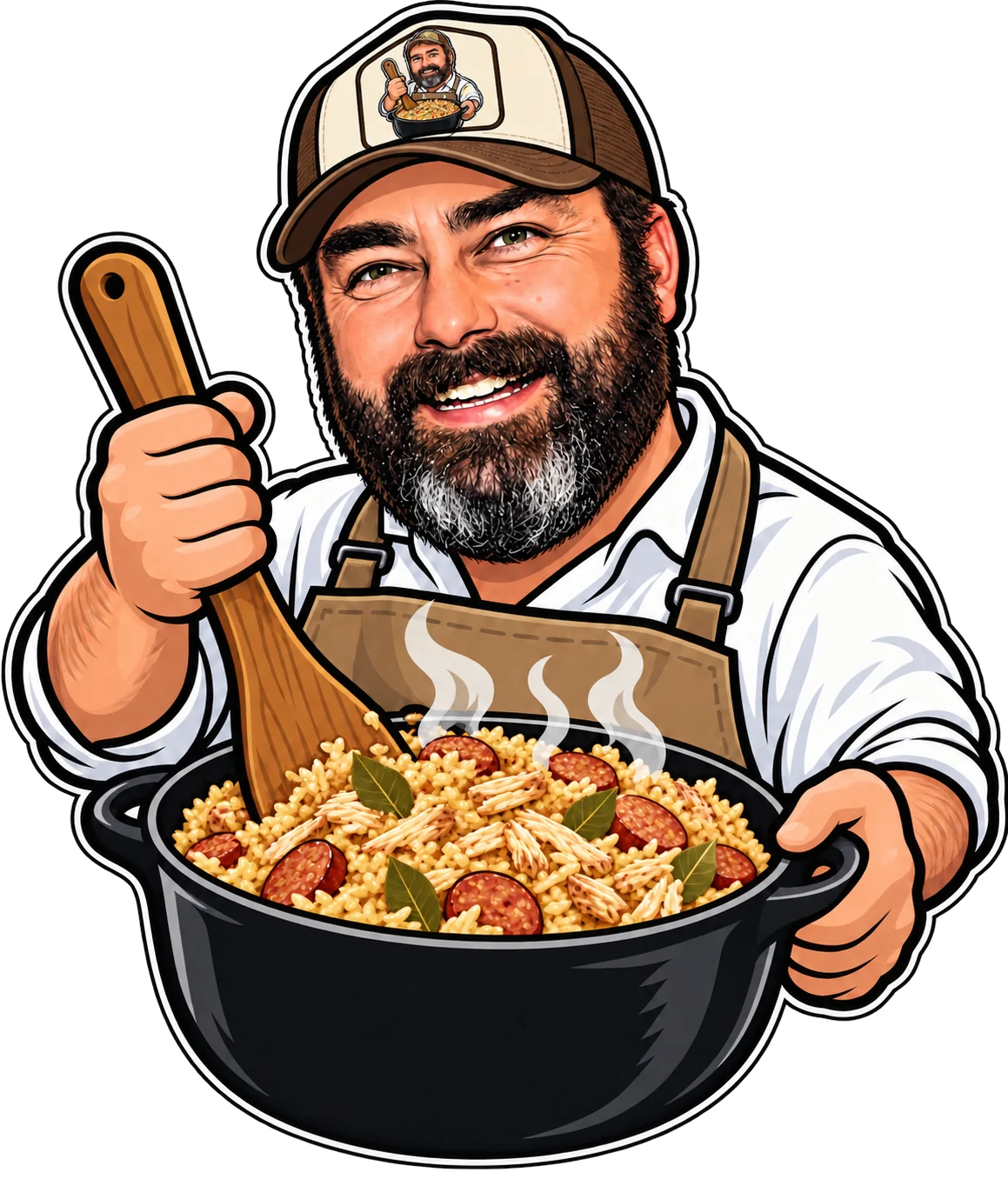
Chicken, smoked sausage, and rice, cooked together in one pot until the rice drinks up every bit of the broth. It comes out wet and heavy — boggy. Not soup, not a casserole. Its own thing, and it belongs to the northeast corner of South Carolina.
Chicken.Sausage.Rice.Salt.Pepper.
Know your rice pots
Pilau
Fluffy. Every grain on its own. The Charleston way.
Charleston
Perloo
Moist, but holds its shape on the plate.
Georgetown County
Bog
Wet, sticky, heavy. Sticks to your ribs and your spoon.
Horry County · correct
The long story
Three hundred years in one pot.
Chicken bog didn't come from a cookbook. It came from rice fields, tobacco barns, church grounds, and a political rally that's older than the light bulb. Here's how a pot of wet rice became the dish of the Pee Dee.
1700s
Rice comes up the Carolina coast
From the early 1700s until the Civil War, South Carolina grew more rice than anywhere else in America. The know-how to grow it in tidal swamps came with enslaved West Africans from the Rice Coast — and so did the habit of cooking rice and meat together in one pot. When Carolina Gold took off in the 1780s, it made the Lowcountry rich. The pot came along with it.
1700s – 1800s
A word travels, and a dish with it
Pilau, perloo, purlow, pillow — all cousins of pilaf, a Turkish and Persian word for a rice dish that wandered into English by way of French and probably Spanish. Every Lowcountry kitchen had its own spelling and its own version. Charleston kept the rice fluffy. Georgetown County liked it moister. Head inland toward the Pee Dee, and it got wetter still.
1800s
The Pee Dee makes it its own
The northeast corner of the state never had the tidal rice fortunes of Charleston. What it had were farms, hogs, chickens, and a lot of mouths to feed at once. In plantation kitchens and farmyards, enslaved cooks simmered chicken, sausage, onion, and rice together in iron washpots over open fires until it was one thing — wet enough to hold together on a plate, rich enough to carry a workday. One Horry County account remembers two of those cooks by name: Gibbie and Pody.
Where the name came from is argued about at every table. Writer James Villas put it plainly: a bog, unlike a pilau, is any stew with wet, soggy rice. Others swear it's for the swampy country the dish comes from. Either way, it stuck.
"A very big pot filled with 400 pounds of chicken, 150 pounds of good pork sausage and 100 pounds of rice will feed at least 1,000 people."
Dr. David Shields, Carolina Distinguished Professor Emeritus, University of South Carolina
1876 →
Politics, preaching, and a pot
On the western edge of Horry County, at a crossroads called Galivants Ferry, candidates started speaking from a stump during Wade Hampton's 1876 campaign for governor. By 1880 the merchant J.W. Holliday had made it a fixture at his store, and the Galivants Ferry Stump Meeting has been held every election year since — one of the oldest political gatherings in the country. Speeches, gospel music, clogging, and chicken bog.
That's the pattern for the whole region. Church homecomings, family reunions, fire-department fundraisers, Friday-night ballgames — if there's a crowd in the Pee Dee, somebody's stirring a pot, and somebody's selling bog plates.
1890s – 1920s
Tobacco country
When bright-leaf tobacco took over the Pee Dee, it brought the busiest weeks of the farm year: putting in tobacco, July and August, when croppers, handers, loopers, and barn crews worked from first light until the last barn was full. Somebody had to feed all of them, and one pot that fed forty was the answer. By the 1920s, bog was the standard crowd meal of northeast South Carolina, cooked on burners pulled out of old tobacco barns. The last barn hung, the pot came off the fire.
1980
Loris throws a Bog-Off
In 1980, Loris put a chicken bog cooking contest on the calendar for the third Saturday in October. It's been there every year since. Today the Loris Bog-Off draws around 35,000 people, more than 200 vendors, two stages, a kids' zone, a national act, and fireworks — and the cook-off is still the point of the whole day. Somewhere along the way Loris started calling itself the Chicken Bog Capital of the World, and nobody's argued.
2023
It's on a marker now
On February 9, 2023, Horry County unveiled a "Hungry for History" marker in front of the Loris Library on Main Street. It's cast in metal, so it's settled.
Chicken Bog
One-pot dish made with rice, chicken & sausage, fed crowds by 1920's. Traditionally eaten after gathering tobacco in northeast South Carolina.
Horry County Historic Preservation Commission · William G. Pomeroy Foundation
October 17, 2026
Which brings us to Taber.
Same street, same third Saturday, same dish that's fed this corner of the state for three hundred years.
That's the whole story. He cooks bog because he loves feeding folks, and you can taste it in every bowl he serves.
Don't ask for the recipe, though. He won't tell you. Neither will the crew. Come to Loris on the 17th and find out for yourself.
The 47th Annual Loris Bog-Off
Come get a bowl.
Saturday, October 17, 2026 Downtown Loris, South Carolina
The cook-off is the heart of the day — dozens of pots, one Main Street, and a panel of judges with the best job in South Carolina. We'll be cooking all morning and serving until the pot's scraped clean.